O
Technical SEO for AI Visibility: Crawlable, Indexable and Citation-Ready Websites
Even if you create the best expert content in your market, it will not help if search systems cannot access it, process it or extract the key message from it. In this guide, we go step by step through how to make your website technically ready for Google and AI-powered search engines.
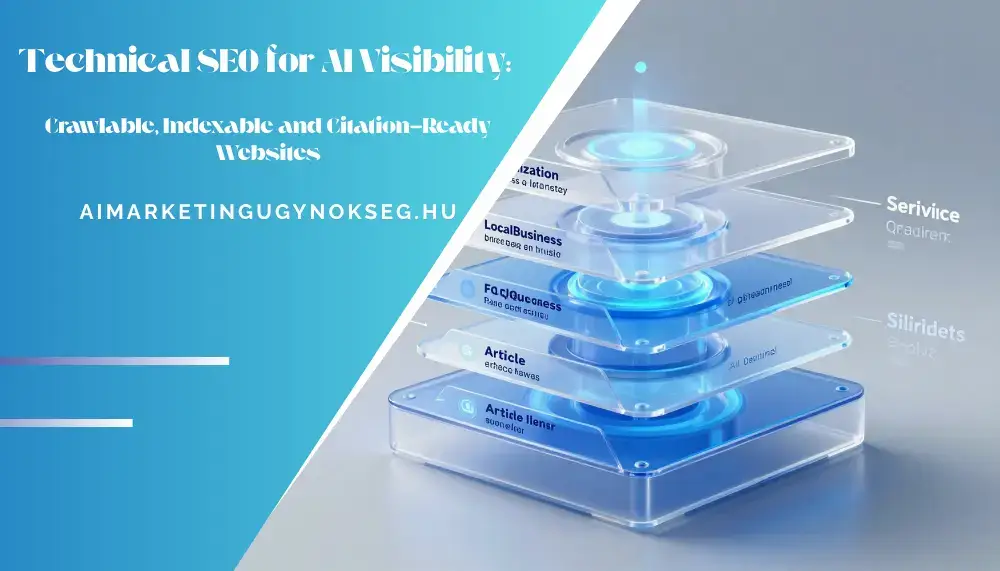
How the machine “sees” your website — click the levels
Good content is still invisible if machines cannot access it
Many businesses make the mistake of investing all their energy into content production while treating the technical condition of the website as a given. But the formula is unforgiving: if search systems cannot properly crawl and interpret the page, even excellent expert content will not appear in Google results or AI-powered search answers. Invisible content, from a business perspective, does not exist.
Technical SEO is therefore no longer only a prerequisite for traditional Google rankings. It also determines how easily a page’s content can be discovered, processed and cited by a generative search system — such as Google AI Overviews, ChatGPT or Perplexity. According to Google’s documentation, crawling and indexing settings determine how search finds and processes website content, and AI features do not require any special “AI file”: classic technical and content SEO foundations remain decisive. If you are not yet familiar with the topic, start with the basics of technical SEO.
What does technical SEO mean in the age of AI-powered search?
The role of traditional technical search engine optimization is to ensure that search engines can find pages, access content, process HTML code, understand relationships between pages, select the correct canonical URL and ultimately index the content that has business value. This task list is already complex by itself, but AI-powered search adds another layer.
From an AI visibility perspective, it is not enough for the system to find the page. It must also be able to easily extract the main claims, definitions, numerical data, author information and the relationships between entities — brands, people, services and concepts. A generative answer system does not “read through” the page the way a human does: it works with clearly separated content units that can stand on their own.
This is why it is useful to think in a three-level model. A page is crawlable if the robot can access it. It is indexable if the system is allowed and able to store it. And it is citation-ready if the content structure makes it easier to extract and use relevant details. It is important to emphasize: “citation-ready” is not an official Google classification, and it does not guarantee appearance in an AI answer. Rather, it describes a content-technical state in which machines can more easily identify precise, self-contained information. We discuss the broader context in more detail in our articles on what AI SEO is and our AI search optimization guide.
1. Crawlability – can search robots reach the important pages?
Everything starts with access. If Googlebot, Bingbot or an AI search crawler cannot reach the page, even the best content remains invisible forever. Three areas should be checked systematically.
Check the robots.txt file
The primary function of robots.txt is to regulate crawler access — not to remove pages from search results. If you definitely want to remove a page from search results, use a noindex directive or password-protected access, not a robots.txt block. This difference is the source of many misunderstandings, and in practice it can cause serious visibility damage.
The most common mistakes we see during audits are:
- accidentally blocking the entire website, usually due to a setting copied over from a staging environment;
- excluding important category or service pages;
- blocking CSS and JavaScript resources, which prevents Google from rendering the page correctly;
- automatically blocking AI search crawlers through the default settings of a security plugin;
- allowing unlimited crawling of parameterized URLs, which wastes crawl budget.
Create a clean XML sitemap
An XML sitemap helps search engines discover important, new or updated URLs — but it does not guarantee their indexing by itself. A sitemap fulfills its role when it contains only URLs that return a 200 status code, are indexable, canonical and commercially valuable. Including redirected, broken, duplicated or noindexed pages adds noise to the system and reduces the reliability of the sitemap in Google’s eyes.
Make every important page reachable with internal links
The problem of so-called “orphan pages” is subtle: even if a service page appears in the sitemap, if no internal link points to it from the menu, categories or other content, it remains peripheral in the eyes of crawlers. Internal links help with URL discovery, understanding relationships between topics, building an importance hierarchy and creating topical clusters. A well-designed internal link network is not only a technical tool, but also a strategic asset — you can read more in our article on building an effective SEO strategy.
2. Indexability – can the page enter search system databases?
Crawling is not the same as indexing
A common misconception is that if Googlebot visits a page, it automatically enters the search index. In reality, a robot can crawl a page without the system eventually storing it. The most common reasons for being left out of the index are:
- a
noindexdirective in the meta tag or HTTP header; - an incorrect canonical URL that points indexing to another page;
- duplicate or highly similar content;
- a weak page with little standalone value;
- redirect chains or loops;
- faulty HTTP status code, such as a soft 404;
- login-protected content;
- faulty JavaScript rendering;
- server error or timeout during crawling.
Canonical tags and duplication
The canonical tag indicates to the search engine which URL should be treated as the primary version of a group of similar or identical pages. Used well, it creates order; used poorly, it can make entire content groups disappear from the index. Typical error patterns include: every page pointing to the homepage as canonical; mixed HTTP and HTTPS versions; parallel www and non-www URLs; parameterized pages indexing independently; category, tag and search pages being created and multiplied uncontrollably.
The difference between robots.txt and noindex
noindex directive, it must be able to access the page. If the URL is blocked by robots.txt, the robot may not see the meta directive placed on the page — so the page may remain in search results even though you think you excluded it. Combining the two tools is one of the most common self-sabotaging settings.If you want to quickly uncover where your site gets stuck in the indexing process, our AI SEO audit service performs exactly this diagnosis.
3. Citation-ready content – how do you make machine extraction easier?
Clear heading hierarchy
The heading structure is the map of machine processing. A well-built page uses a single H1, followed by logically structured H2 headings that divide the main argument, while H3 headings cover sub-problems. Where users also search in the form of questions, it is worth using question-style subheadings. Headings should not merely list keywords: they should clearly state which question the section answers — this helps the generative system know exactly which block may be worth citing.
Use self-contained answer blocks
At the beginning of every important section, include a short, direct summary. A good answer block is 40–80 words long, answers the question in the first sentence, does not require knowledge of the previous paragraph, names the important entities, avoids vague pronouns, and clearly separates facts, opinions and assumptions. Here is what it looks like in practice:
Why is technical SEO important for AI visibility?
Technical SEO ensures that search engines and AI-powered search systems can access, process and properly interpret website content. If a page is blocked, incorrectly indexed or difficult to process, it is less likely to appear in search results and as a source in generative answers.
Good title and meta description
The meta description is not always displayed unchanged: Google may choose a more search-relevant snippet from the page content. That is why not only the meta description, but also the visible text itself must be clear, concise and easy to extract. The title and meta description are the invitation — but every paragraph of the content is a potential snippet.
Provable and precise claims
AI systems and Google’s quality evaluation principles point in the same direction: credible, verifiable content has an advantage. This is supported by the author’s name and professional introduction, publication and update dates, primary sources, proprietary measurement data, methodology descriptions, specific examples and clear definitions. If you are interested in the practical side of content creation, read our guides on creating SEO-optimized blog articles and entity-based SEO for AI visibility.
4. Structured data: a machine-readable explanation of page content
Structured data — most often Schema.org markup in JSON-LD format — communicates information about page content and its type in a standardized form. It can help Google recognize, for example, the author of an article, a business, a product, a service or a video. For blog content and company websites, the most relevant types are: Organization, LocalBusiness, Article or BlogPosting, Person, Service, Product, BreadcrumbList, VideoObject and ImageObject.
We explain the topic in detail in our article on Schema Markup and extra search visibility.
5. Managing AI search crawlers and traditional search crawlers
Website owners today must make decisions in three separate areas: traditional search crawling, AI-powered search appearance, and data use related to model development. These are not the same processes, and they are not handled by the same robots.
OpenAI, for example, uses one crawler for serving ChatGPT search features and another for possible model-development-related crawling: OAI-SearchBot is connected to ChatGPT search appearance, while GPTBot can be managed to control access for possible model-development purposes. The two settings are independent — a website can allow OAI-SearchBot access while blocking GPTBot:
Important: the example above is not a universal recommendation, but one possible configuration. Which robot you allow or block is a business and privacy decision — depending on your visibility goals, the value of your content and the competitive situation. If you are unsure, an AI search optimization expert can help define the right strategy.
6. JavaScript, mobile rendering and site speed
Important content should be in the rendered HTML
Content on JavaScript-based pages can also be processed, but it is important to understand that crawling, rendering and indexing may be separate processes. Blocked JavaScript files or faulty client-side rendering can prevent content processing — the page works perfectly for the user, but the robot sees empty or incomplete content. Check regularly:
- Does the main content appear even without JavaScript?
- Does the navigation use real HTML links?
- Does the robot see the same content as the user?
- Do structured data load in the rendered version?
- Do canonical and robots meta tags work properly?
- Are crawlable, standalone URLs available alongside infinite scrolling?
Mobile content parity
Google primarily uses the mobile version of content for indexing and ranking. In practice, this means that if a content element is available only in desktop view, it does not exist from an indexing perspective. The main text, internal links, images, alt text and structured data must also be available on mobile. A responsive, mobile-first structure is no longer optional — it is a baseline requirement, as we also explain in our article on SEO-friendly website creation.
7. Technical SEO audit for increasing AI visibility
The points above require regular, structured checks. The following four-step audit process follows our agency practice and can be applied to websites of any size.
1. Crawlability check
robots.txt · XML sitemap · internal links · orphan pages · redirects · broken URLs · server log analysis
2. Indexability check
noindex tags · canonical URLs · duplicate content · HTTP status codes · Google Search Console indexing report · rendered HTML · mobile version
3. Content processability
H1–H3 hierarchy · short answer blocks · clear entity naming · author data · dates · references · captions · image alt text
4. Structured data check
appropriate Schema.org types · critical errors · alignment with visible content · rich-result eligibility · Rich Results Test
Google’s official testing tool, the Rich Results Test, can be used to check which supported rich results the page’s structured data may be eligible for. For the full process and professional implementation, our AI SEO audit and website search engine optimization services provide support.
Technical SEO checklist for AI visibility
With the interactive list below, you can review where your website currently stands in minutes. Tick what is already in place — the list measures your progress.
AI visibility quick check
0 / 13✔ All 13 points are checked — your website is technically ready for AI visibility!
„`Summary – AI visibility starts with technical foundations
AI visibility cannot be achieved merely by writing longer articles or adding more Schema Markup. The correct order is always the same: the content must be accessible, indexable, clearly structured, contain precise and verifiable information, be easy to extract, and connect to a credible brand and topic area. Technical SEO alone does not guarantee that a page will appear in an AI answer — but its absence can significantly reduce the chance. The competition is often decided where most people do not even look: at the code level.
Frequently Asked Questions
What is the difference between crawling and indexing?
Does Schema Markup guarantee appearance in AI answers?
Can GPTBot be blocked while OAI-SearchBot is allowed?
Why does a technically accessible page not appear in Google?
Is an XML sitemap enough for page discovery?
Is your website ready for the age of AI search?
If you are not sure whether your website technically meets the requirements of Google and AI-powered search engines, request a personalized SEO and AI visibility analysis — and we will show you point by point where you are currently losing visibility.
Request an AI visibility analysis

