
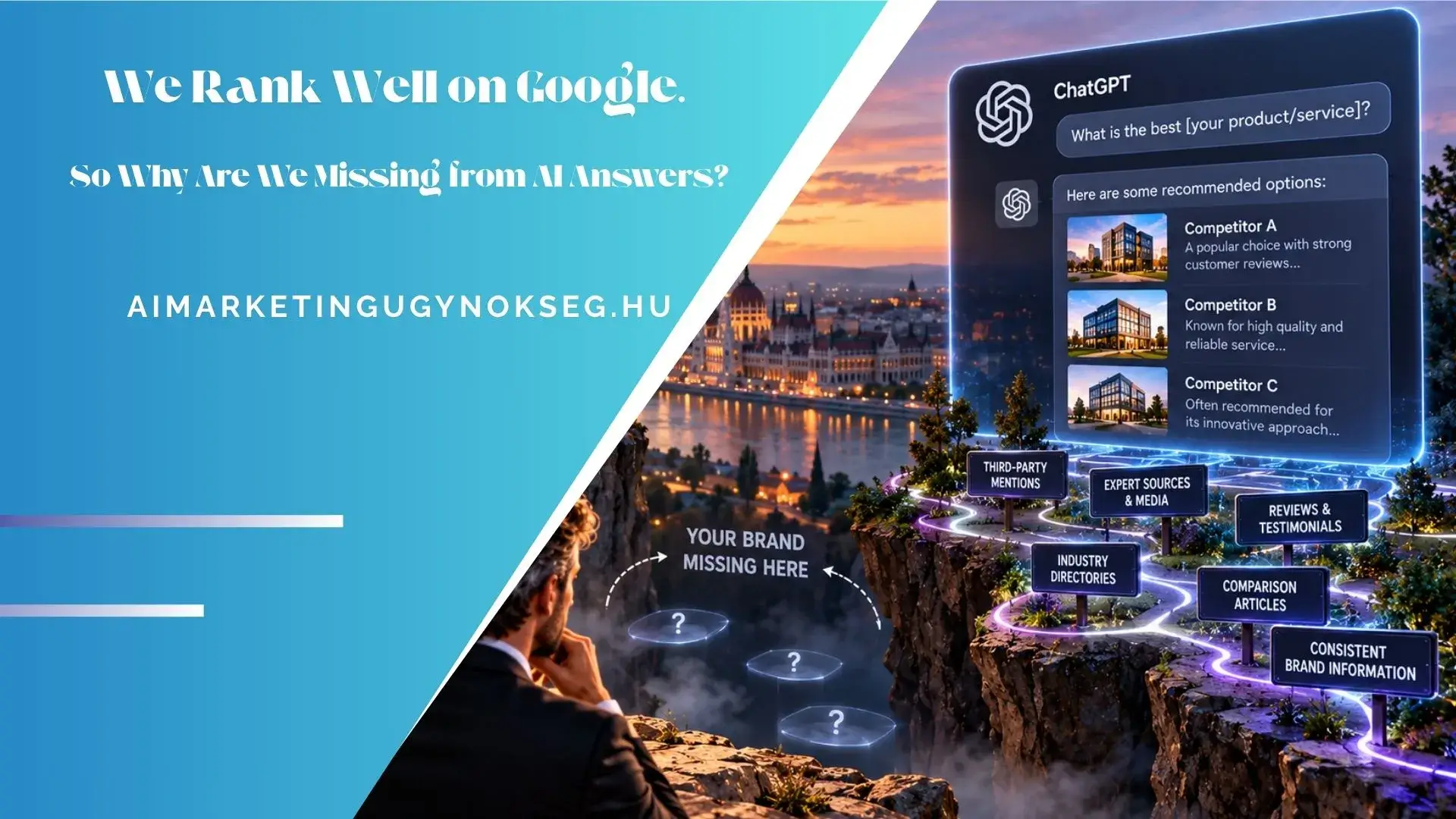
We Rank Well on Google. So Why Are We Missing from AI Answers?
O
A strong ranking is a valuable foundation. But when a customer asks a complex question, simply being findable is no longer enough: what also matters is what evidence, comparison criteria and useful answers can be found about you.
Does this sound familiar? Your website ranks prominently for your important keywords, the work invested in search engine optimization is producing visible results, yet you still get an unpleasant surprise. You ask ChatGPT, Gemini or another AI assistant which service provider is worth choosing in your market – and your competitors appear in the answer. You do not.
The first reaction is often that some technical error has occurred or that search engine optimization has suddenly lost its value. Neither conclusion necessarily follows. Traditional search rankings and appearing in an AI-generated answer may be related, but they are not the same task and they are not measured by the same standard.
In one situation, a page competes in a results list for a specific search. In the other, a system may be trying to assemble an answer to a task containing several sub-questions, using different sources. A strong ranking can help, but by itself it does not prove that your page contains everything required to support a decision.
In short: there is no single secret setting you should be looking for. Rankings, accessibility, credible external mentions and answers to specific customer questions should be examined together. No single factor guarantees that you will appear in an AI answer.
Google Rankings and Presence in AI Answers Are Not the Same Thing
When someone searches for “SEO Budapest,” the search engine may rank different pages for that query. A question asked of an AI assistant, however, may sound like this: “Which Budapest agency can help a mid-sized webshop if technical SEO, content and transparent reporting are all important?”
The second question combines several conditions: geography, company size, industry, technical expertise, content creation and expectations around cooperation. A system may try to explore the topic through several related searches. Google, for example, explains that some of its AI features may use multiple related searches to build a complex answer. This does not mean that every assistant works in the same way.
It is also important to distinguish between situations where a tool is actively searching the public web and situations where a model relies on its existing knowledge. The displayed answer may differ by platform and context; the wording of the question, location, language and previous conversation can all influence what the user sees.
| Factor | Traditional Search Situation | Complex AI Answer |
|---|---|---|
| Common starting point | A phrase or search intent | A question that may contain multiple conditions |
| User result | Search results to choose from | A summarized answer that may contain sources |
| Important evaluation point | Indexing, relevance, ranking and click-through | Accessibility, meaningful answers, supporting evidence and citations |
| What does it not mean? | A strong ranking does not guarantee a business result. | A mention or citation does not guarantee a click or customer. |
The lesson is not that search engine optimization should be stopped. Quite the opposite: the technical and content foundations remain important. The evaluation simply needs to be expanded to include how well your website helps answer buyers’ more complex questions.
Customers Do Not Buy Keywords – They Choose Solutions
A keyword list is a useful map, but it does not necessarily reveal the entire decision-making process. A prospective customer does not only want to know whether a service exists. They also want to know whether it is suitable for them, how it differs from alternatives, how much commitment it requires, what risks to expect and what they receive for their money.
Consider a webshop that ranks well for “office chair.” That alone does not automatically answer which chair is suitable for eight hours of daily use, how adjustable it is, which body height it suits, how the warranty works or how long delivery takes. A user may combine all of these into a single question.
The same applies to business services. A page created around the term “accounting firm” may not guide a decision-maker looking for a partner for international invoicing, a special company structure or managing multiple locations. If your page contains only generic promises, an essential part of the buyer’s question may remain unanswered.
How to Find the Missing Questions
- Review the questions customers ask before requesting a quote and during the first consultation.
- Collect recurring objections, uncertainties and comparisons received by customer service.
- Examine which topics appear in Search Console queries and which pages prospects reach.
- Ask the sales team: which missing pieces of information most often delay a decision?
- Prioritize questions by business importance: what helps a good prospect decide whether it is worth speaking with you?
The goal is not to create a separate page for every possible wording. Instead, build genuinely useful content that handles related questions with appropriate depth and transparency. A meaningful answer is more important than artificially multiplying pages.
Check This First: Is Your Page Accessible at All?
Even the best professional content cannot help a system built on web search if it cannot access the page or if the essential content cannot be read. Technical verification is therefore not spectacular, but it is an essential starting point. At the same time, different search engines and assistants may use different systems and rules.
Can the Page Be Found?
Review internal links, the sitemap and robots.txt rules. Important pages should not be accessible only through a difficult-to-find menu.
Can It Appear in Search?
Use Google Search Console’s URL Inspection tool to check indexing status, the canonical URL and possible exclusions. A noindex setting can prevent Google indexing.
Is the Content Readable?
Check whether important text and product data are accessible to the search engine and are not displayed exclusively as images or within an interface that is difficult to process.
Are There Excessive Restrictions?
Settings that restrict snippets may affect what the search engine can display. Always evaluate these rules together with your content and business objectives.
According to Google’s official guidance, for a page to appear as a supporting link in Google Search AI features, it needs to be indexed and eligible to appear with a search snippet. Eligibility does not guarantee appearance. It is also worth checking Search Console’s current site-level settings related to generative AI features.
Other platforms may have separate rules. OpenAI’s documentation, for example, distinguishes OAI-SearchBot, which is associated with ChatGPT search functionality, from GPTBot, which is used for model development. Allowing a search crawler and managing crawling for training purposes are separate decisions; allowing access does not mean automatic citation. Before making changes, check the official documentation and consult your developer.
Important: you do not need to allow every crawler indiscriminately. Make access decisions based on content protection, business interests, site load and the current rules of the relevant service provider.
Structured data can help systems understand content and support certain types of search presentation, but it is not a magic solution. According to Google, there is no special schema or mandatory separate AI text file required to appear in its AI features. llms.txt may be useful for other services, but it is not required for Google search visibility and does not represent a proven advantage there.
A Claim Is Not the Same as Evidence
“We are customer-focused.” “We provide high-quality service.” “We have an experienced team of experts.” Almost any competitor can write these sentences. The question is whether a prospective customer – and a system looking for information – can find verifiable details behind those claims.
If, for example, you claim expertise in webshop SEO, show what types of tasks you handle. Explain how you examine category pages, filters, product data or duplicate content. If you can present client work, describe the starting situation, the methodology and the measurement period. When presenting results, indicate what changed and what cannot confidently be attributed to a single intervention.
A case study is useful when it is more than a success story. It should include the circumstances, limitations and the types of businesses that can learn from it. Publish client data or internal figures only with appropriate permission; anonymize where necessary. Do not invent results, and do not present an individual example as a promise that applies to every customer.
What Types of Evidence Can Support a Decision?
- Real case studies: with a clear description of the problem, intervention, measurement and lessons learned.
- Your own professional experience: methods, criteria and limitations learned through real work.
- Transparent expert background: identified authors, relevant experience and accessible organizational information.
- Verifiable sources: professional documentation, original research or clearly identified data sources.
- Real customer reviews: preferably including specific experiences, published lawfully and with consent.
Credibility does not come from a single signal. An author profile, customer review or data point does not guarantee visibility on its own. The goal is for your claims, taken together, to become more believable, detailed and useful for decision-making.
Write Answers That Actually Move the Customer Forward
A common misconception is that content for AI must be written in some special machine-oriented language. The useful starting point is much simpler: answer exactly what your target audience wants to know. Provide the right context, state the conditions and do not hide the main point behind long, generic introductions.
On a service page, for example, do not merely state that “we create a customized strategy.” Explain in which situations you recommend the service, what information is required to begin, what the main stages of the work are, what cooperation you expect from the customer and what is not included in the package. If the price depends on many factors, you can explain the factors that influence pricing instead of giving an exact amount.
Less Useful Answer
“SEO helps businesses increase their online presence. A customized solution is required in every case.”
Decision-Supporting Answer
“For a webshop, the work often begins with reviewing indexing, category pages and product data. The order is determined by the technical condition, search demand and business objective.”
The second wording does not guarantee citation either, but it provides more information for the decision. It identifies the situation, the areas examined and what determines the order. Depending on your actual service, you can add even more specific details.
Good Structure: For the Reader, Not for an Imaginary Algorithm
Use descriptive subheadings, short summaries, clearly divided paragraphs and, where appropriate, comparison tables. A frequently asked questions section is valuable when it answers real questions, not when it simply repeats the same keyword again and again. Length should match the topic: there is no universally guaranteed word count.
Update information that can change quickly: prices, availability, supported features, legal references or product characteristics. If something is uncertain, say so. A precise limitation is often more valuable than a confident but unsupported promise.
What You Say About Yourself Is Not the Only Thing That Matters
Your website is your brand’s own platform, but prospects may research you in many other places. They may read a professional interview, customer review, industry comparison or company profile. These sources can shape the picture of what you do, who you help and why you may be relevant in a specific situation.
It is therefore worth checking whether the company name, website address, service scope, contact information and expert profiles are consistent across important platforms. An outdated profile, old phone number or previous service description may not cause a problem by itself, but together they can make the overall picture uncertain.
Valuable external presence is not the same as mass-produced artificial mentions. Instead, think in terms of appearances that reach a real audience: professional articles, relevant discussions, industry presentations, partner case studies or credible customer feedback. Google’s guidance explicitly recommends caution regarding inauthentic mentions created for manipulation.
If you do not appear on a comparison page, first examine how the list was compiled. Your service may not belong to the category being evaluated, or the editors may simply be unfamiliar with your work. You can contact them with relevant, accurate information, but do not treat inclusion as a guaranteed placement that can simply be purchased, and always respect editorial independence.
How Do You Know Whether You Are Really Missing?
A single test question is not market research. AI answers can change, so a check such as “I asked once and it did not mention us” is more of a warning signal than a final diagnosis. Build a simple, repeatable test that produces observations you can compare over time.
Create a Relevant Question List
Select, for example, 15–30 questions from different stages of the customer journey. Include general research, method comparisons, specific problem-solving, service-provider selection and brand-focused questions. Base the questions on real decision-making situations experienced by your own customers, not merely on how you would like them to find you.
Record the platform tested, date, exact question, language, location, whether there was prior conversation context and whether you were logged in. Repeat the test under similar conditions whenever possible. If personalization or location-based results may play a role, record that as well. Do not calculate market-share-style percentages from a handful of answers unless the data supports such a conclusion.
Separate Mentions, Citations and Business Results
- Brand mention: does your company or service appear in the answer, and in what context?
- Source citation: does your website appear as a clickable source, and which page does the citation point to?
- Message accuracy: are the statements about your service, expertise and availability correct?
- Traffic: can recognizable referral sources be identified in analytics? The source of some visits may be incomplete or unidentifiable.
- Business impact: are relevant inquiries, quote requests or purchases arriving, and what do customers say about how they found you?
Google Search Console performance data may include impressions and clicks originating from Google’s AI features within web search data. Also check whether your account provides a separate report related to generative AI; features and availability may change over time. Bing Webmaster Tools’ AI performance reports may help examine citations appearing across supported Microsoft experiences and certain partner integrations, but they do not measure the entire market of AI assistants.
Alongside analytics data, it is worth asking customers a simple question: “Where did you first encounter us?” The answer is not a perfect measurement, but it can reveal touchpoints that technical source attribution does not capture. Measurement should remain proportionate, and all data handling should comply with applicable consent and privacy requirements.
Five Mistakes That Distract from the Real Problem
1. Drawing Far-Reaching Conclusions from One Answer in One Tool
System answers can change. The correct response is not panic, but regular, documented checking. Examine which question groups and which platforms repeatedly show the problem.
2. Focusing Exclusively on Crawlers
Access may be a prerequisite, but permitted crawling does not automatically make your page useful or credible. Technical improvements should be handled together with content and business analysis.
3. Republishing the Same Text Under Many Different Titles
If you create a separate, barely different page for every variation of a question, this can easily lead to fragmented, repetitive content. One clear and comprehensive page is better when it can naturally answer the related questions.
4. Using Exaggerated Promises Instead of Evidence
“Guaranteed first place” or “guaranteed appearance in every AI answer” is not a responsible promise. As an external party, you cannot fully control the display decisions made by search engines and AI assistants.
5. Confusing Visibility with Results
A citation can be encouraging, but a business usually does not exist simply to be mentioned. Measure whether you reach relevant people and whether it is easy for them to take the next step.
What Should You Do Over the Next 90 Days?
You do not need to rebuild your entire website at once. The following plan is a practical framework that should be adapted to the size, resources and business objectives of your company. It is not a promise that any system will definitely cite you within 90 days.
Assessment and Baseline
Select your most important services and target groups. Build a question list, document current answers and examine the indexing, accessibility and search performance of priority pages.
Content and Evidence
Fix the most important technical obstacles. Add real decision criteria to key service or product pages, update company information and create one credible professional example that can legally be published.
Visibility and Remeasurement
Build relevant professional relationships, update important external profiles and repeat the question-based test. Compare changes with traffic and the quality of incoming inquiries.
Learning and Refinement
Record what you changed and when. Monitor which content helps customers, which questions remain unanswered and what new information sales or customer service continues to request.
The order matters. If the page cannot be indexed, investigate that obstacle first. If it is accessible but every competitor answers the important questions in greater detail, address the content gap. If your own site is strong but company information is scattered and contradictory across the web, organizing the brand environment may become the priority.
The work should be assigned to clear owners: who checks the technical side, who approves professional claims, who updates the data and who prepares the monthly summary? This ensures that AI visibility does not remain a one-time campaign but becomes part of the existing marketing and sales process.
Frequently Asked Questions About AI Visibility
If I Rank First on Google, Will I Definitely Appear in AI Answers?
No. A strong search ranking is an important signal and can be a useful foundation, but different systems may use different questions, sources and display methods. Ranking alone does not guarantee a brand mention or source citation.
Do I Need to Change My Entire SEO Strategy?
Not necessarily. First examine how well your existing strategy covers customers’ decision-making questions and whether the technical foundations are in order. In many cases, the right approach is to extend the existing work rather than replace it completely.
Does It Help If I Create a Large Number of Articles with Artificial Intelligence?
The tool itself does not determine the value of the content. What matters is originality, accuracy, professional review and usefulness to the user. Large volumes of repetitive or misleading content do not replace real experience.
Is One FAQ Page Enough?
It can be useful if it provides meaningful answers to real customer questions, but it is not a guarantee by itself. Many answers belong on the relevant service, product or informational page together with the necessary context.
Can Guaranteed Inclusion in an AI Answer Be Purchased?
There is no general guarantee that applies across all systems. Paid advertising opportunities and organic citations should be treated separately. Be cautious with any offer promising guaranteed visibility on third-party platforms.
How Long Does It Take to See Results?
There is no universal timeframe that applies to every business. It depends on technical condition, content quality, competition, the platform being examined and the question itself. Regular measurement helps you understand change, but cause and effect often cannot be proven from a single modification.
The Next Step Is Not a Trick, but a Better Evidence System
If you already rank well on Google, you have something valuable to build on. The question is whether that visibility also matches the complex decision-making situations in which your customers now seek help. Are your pages findable and accessible? Is it clear what you are competent in? Do you answer the important questions? Do you show what your claims are based on?
Search rankings, technical accessibility, relevant content and credible external presence together can provide a stronger foundation. None is a magic button. But publishing more useful, accurate and verifiable information does more than help with visibility analysis: it can also make the decision easier for the prospects who eventually reach you.
Professional Sources
The following official documentation can help verify the technical and measurement-related claims. Services and their settings may change.


