O
Imagine the scene. A decision-maker does not type a keyword into Google, but asks ChatGPT: “Who is the best [your industry] provider in Hungary?” A few seconds later, they receive the answer — a short, confident list of five names. Your company is either on it, or it is not. There is no second page to scroll to. No “see full list of results.” Just the five names.
And here comes the uncomfortable truth: whether your company appears on that list depends less and less on what you write on your own website — and more and more on what others write about you.
This is the meeting point between digital PR and Generative Engine Optimization (GEO). And this is the point where most brands are currently invisible.
AI does not look at your shop window. It reads your references.
In traditional SEO, your own website was the main character: headings, keywords, internal links. Generative engines — ChatGPT, Perplexity, Gemini, Google AI Overviews — think differently. When a user asks a category-level question, the model does not sit down to read your company’s “About us” page. Instead, it looks at who talks about you, and in what context, across independent and trusted sources.
This is not an accidental design choice. AI models are built to look for consensus and third-party validation. If a trade publication, news outlet, or industry media source voluntarily mentions your brand in connection with a topic, based on an editorial decision, that is evidence for the model: this entity exists, is credible, and is connected to this topic. Your own marketing copy is worth only a fraction of that — because you wrote it about yourself.
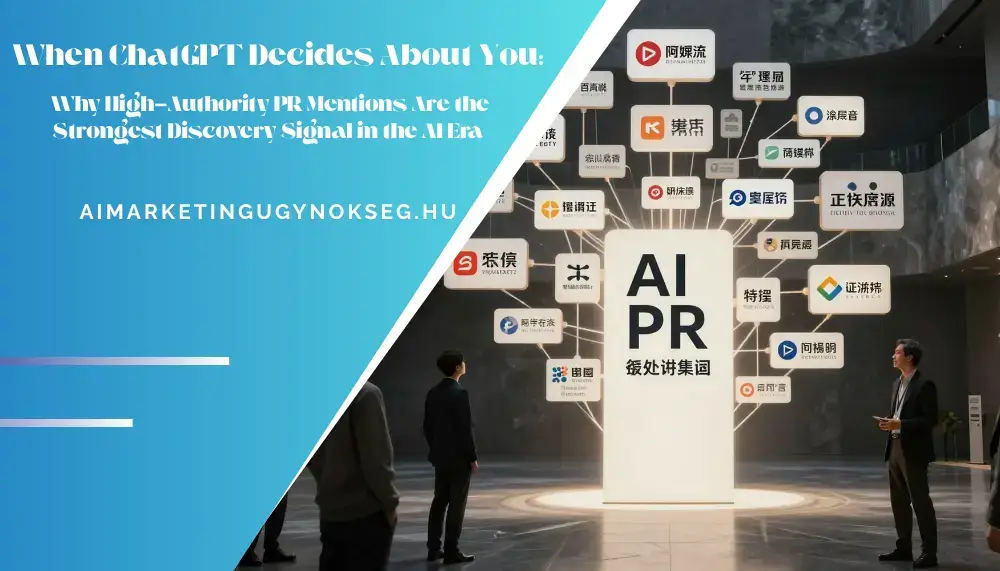
That is exactly why we say: an earned PR mention on a high-authority website is now the strongest discovery signal for AI models.
This is not an opinion. This is what the 2026 data says.
It would be easy to dismiss this as the usual enthusiasm of marketers. But the research points in a clear direction.
A 2025 arXiv study on generative search optimization found that AI search systems show a clear bias toward earned media and other independent, authoritative sources — over a brand’s own content and social posts. In plain language: when AI can choose whom to cite, it almost always chooses the source independent of you. PR is precisely the function that gets your brand into those sources. If you are not there, you do not even make it onto the list of possible citations.
Princeton’s GEO research added another important piece to the puzzle: it found that adding concrete statistics and data was the most effective GEO tactic, increasing visibility by up to 40%. AI loves numbers, named facts, and citable evidence. It skips vague, generic marketing messages.
And is this just a passing trend? In April 2026, Gartner predicted that brands’ PR and earned media budgets could double by 2027 — specifically to drive visibility in AI answer engines. When an analyst firm like that tells a budget line to “double,” that is not noise. That is an infrastructure-level shift.
Add the most telling data point: by early 2026, AI systems were increasingly drawing from authoritative sources regardless of their organic rankings. In other words, even if you rank first on Google for a keyword, AI may still cite someone else — if someone else is mentioned more often and more credibly in the press.
Why does this work? Three mechanisms.
1. Entity authority. AI models build knowledge graphs: they connect entities — companies, people, products — with topics. The more often your brand appears next to a given topic in trusted sources, the stronger that connection becomes. Even unlinked mentions matter — the mere co-occurrence of your name and the topic strengthens entity recognition.
2. Cumulative trust score. Every positive mention from an authoritative source adds to an invisible “trust account.” AlgoAI interprets these mentions as signals of credibility and expertise. This is cumulative: a campaign that produces twenty placements keeps working for you eighteen months later, because the content remains, the references continue passing authority, and the mentions accumulate. This is structurally different from paid advertising, where visibility disappears the moment you stop spending.
3. Independent validation. PR and SEO do different jobs. Your own website ensures that your company can be crawled and understood. PR ensures that AI finds external validation that your brand deserves trust in the first place. Together, they close a loop that neither can close on its own.
The honest part few agencies say out loud
GEO is not magic, and we do not promise “first place” — because in AI search, there is no such thing. Citations fluctuate, individual models weigh signals differently, and the user’s context also influences what appears in the answer. The right mindset is brand building: you do not acquire a fixed position, you increase your probability across thousands of visibility moments. Those who do this consistently, across many surfaces, over the long term, appear more often, more accurately, and in better context. This is not a slogan — this is reality, and that is exactly why it is worth taking seriously.
How we combine PR with GEO
Most agencies treat the two separately: the PR team drives media placements, the SEO team optimizes keywords, and the two never talk to each other. We break down exactly that wall. For us, every PR placement is also a machine-citable asset. Our process:
1. Entity-based story planning. Before we write to a single journalist, we define what kind of entity your brand should become in the eyes of AI, and which topics it should be connected to. The placement is not self-serving — it builds your position in the knowledge graph.
2. Data-driven, citable content. We create original data, surveys, and concrete numbers that editors are happy to publish — and that AI is happy to cite. This serves both media relations and GEO visibility according to the Princeton principle.
3. High-authority, real earned placement. We do not target paid sponsored sections or mass press releases — these are worth almost nothing to AI. We build real editorial placements in the most authoritative publications in your field.
4. Machine readability at the source and on your own site. We make sure both the placements and your own pages are structured in a way models can process easily: clear claims, extractable evidence, and proper schema markup. Even the best PR gets lost if your own website is not technically ready for it.
5. AI visibility measurement. We do not guess. We track how often and in what context ChatGPT, Perplexity, Gemini, and Google AI Overviews mention you — and how large your share is compared with your competitors. In 2026, AI citation tracking is no longer an extra; it is a core KPI.
The point
Search has transformed: buying decisions increasingly happen inside an AI answer, not on a search results page. And in that answer, the brands included are the ones trusted sources talk about. Digital PR and GEO are not two separate tactics — they are two returns on the same investment. Whoever begins building authority on high-prestige platforms now will shape how AI interprets their industry for years to come.
The question is no longer whether it is worth it. The question is where you will stand by the time your competitors realize it too.
Would you like to see how often and in what context ChatGPT, Perplexity, and Gemini mention you in your own industry today? We prepare an AI visibility diagnostic that shows where you stand — and where your competitors stand.


