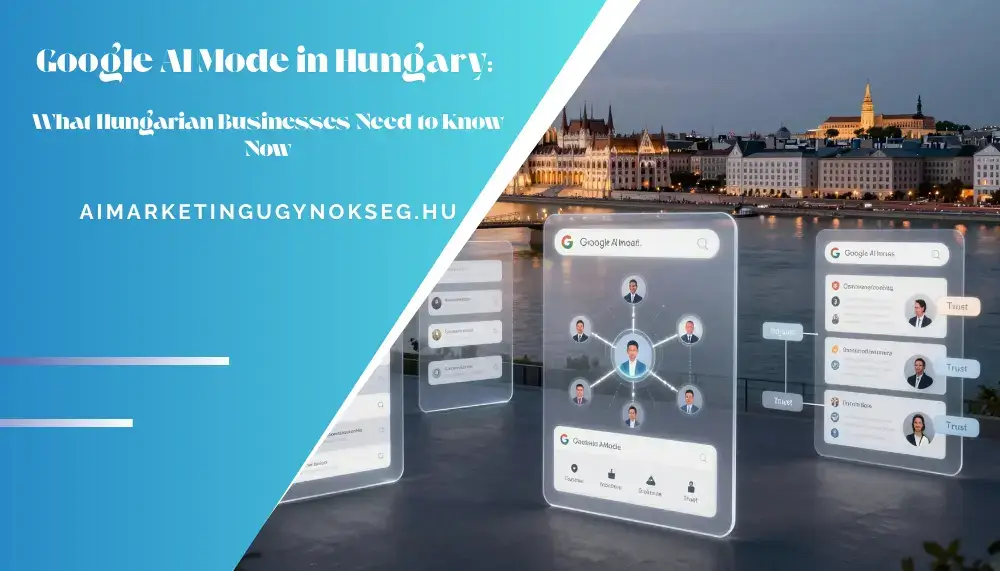
Google AI Mode in Hungary: What Hungarian Businesses Need to Know Now
O
Google Search no longer simply lists results: it asks, compares, evaluates and recommends. In this guide, we show how AI Mode works, how it differs from familiar search, and what a Hungarian business can do to appear in AI-generated answers as well.
„`Click the buttons and see how the same buyer intent transforms from a keyword into a complete, conversational question.
A few years ago, a potential customer would have typed only this into Google: “accounting firm Budapest”. Today, they are increasingly likely to ask instead: “Which Budapest accounting firm would you recommend for a ten-person company working with international clients, where English-language administration is important?”
Traditional search responded to this with a results list ranked by keywords, leaving the user to sort through the options. Google AI Mode, by contrast, interprets the complete problem: it breaks the question into sub-tasks, runs parallel searches, compares sources and then assembles one coherent answer — with source references included.
For Hungarian businesses, the question is therefore no longer only “can our website be found in Google?”, but also whether Google AI understands, trusts and uses the information about our business.
We call this broader shift AI visibility: the ability of a brand to appear, receive citations or become a recommendation in answers generated by artificial intelligence.
What is Google AI Mode?
Conversational search instead of the traditional results list
Google AI Mode is the search giant’s advanced AI-assisted search experience. Users can ask multi-line, complex questions in natural language, then refine, narrow or redirect the result with additional questions — just as they would in a conversation. The system does not simply match keywords; it tries to understand the intent behind the question.
Complex questions
Interpreting long questions with multiple conditions in a single query.
Follow-up questions
The conversation can continue: clarification, narrowing and new criteria can be added.
Multimodal input
Text, voice and image-based search are all supported.
Comparison
Answers assembled from multiple sources, decision situations, and cited web pages.
According to Google’s description, AI Mode breaks the incoming question into multiple subtopics, then launches parallel searches for them. This process is called query fan-out: behind one complex question, several different search processes run at the same time, and the system builds the final answer from these results. From a business perspective, this means that your website can enter the answer not only through the main question, but through any subtopic as well — if it is considered a relevant and trustworthy source there.
Also available in Hungary
In July 2026, Google’s official support list shows Hungary and the Hungarian language as available. AI Mode is therefore no longer a distant experiment affecting only English-speaking markets; it is part of the domestic search experience. At the same time, some additional features, interface elements and premium capabilities may vary by account or subscription plan — but the essential point remains unchanged: Hungarian users are already searching conversationally today.
What is the difference between AI Mode, AI Overviews and traditional search?
These three surfaces are often mixed together in everyday language, even though they operate according to different logics — and they create different tasks for businesses. Click the tabs to compare them:
„`The user types in a keyword, and Google displays a ranked list of results. Selection, comparison and decision-making remain the user’s task. For decades, the main goal for businesses was clear here: to secure the best possible organic position for important keywords.
AI Overviews are AI-generated summaries that appear at the top of the traditional results page. They answer the question briefly and may show related web sources. The results list remains below, but some users already receive what they need from the summary.
AI Mode provides a more independent and conversation-centered experience. The user does not receive only a one-time answer; they can continue asking, compare options and refine criteria as they go. According to Google’s official documentation, AI Mode is especially useful for questions that require further exploration, reasoning or complex comparison.
It is important to see that the three levels do not replace one another; they complement one another — and all three build on the same foundation: Google’s search index. AI SEO, GEO and AEO are therefore different but closely connected approaches; the detailed differences are explained in our AI SEO, GEO and AEO guide for Hungarian businesses.
„`Why does Google AI Mode matter for Hungarian businesses?
Buyers are already formulating complete problems
Short keywords are not disappearing, but detailed, natural-language questions are joining them — the kind of questions people previously would have asked a friend or consultant:
- Which heat pump is suitable for a 100-square-meter family home?
- What kind of accounting firm should a foreign-owned Hungarian company choose?
- Where can I find a reliable dental clinic in Budapest with English-language administration?
- Which Hungarian online store delivers premium office furniture outside Budapest?
- Which AI marketing agency can help with visibility in Google AI Search?
These questions cannot be answered by a single product page or a single keyword. Google must connect the service, location, target audience, price, expertise and trust signals — in other words, the full picture that the business has built, or failed to build, through its digital presence.
Selection becomes more important than ranking alone
In traditional SEO, getting onto the first page was the main goal. In the world of AI Mode, ranking still matters, but it is also important whether the system:
- recognizes the business as an independent entity;
- understands its expertise and services;
- considers its claims credible;
- uses its content to assemble answers;
- cites its website as a source;
- recommends the company to the user in a concrete decision situation.
For local service providers, precise geographic and professional positioning is especially important. You can read more about this in our guide to AI search visibility for Budapest brands.
How can a website be prepared for the Google AI Mode era?
The good news: there is no secret switch that needs to be flipped. According to Google’s official position, there is no separate “AI Mode registration”. The basic requirement for appearance is that the page is indexed, meets Google’s technical requirements and is eligible to display a search snippet. That is where the work begins — in six connected steps.
„`1. Make it technically crawlable and indexable
What is not in the index cannot appear in AI answers either. Checking the technical foundations is therefore not optional warm-up work, but the entry point of the entire AI visibility strategy. Use the interactive list below to go through the most important areas — check what is already in order:
Technical quick audit
0/10 doneIf you get stuck on any of these points, it is worth involving professional support: website search engine optimization and a detailed SEO analysis are designed to uncover and remove exactly these technical barriers.
2. Create directly citable answers
AI Mode assembles answers — and for that, it needs answers, not generic company-introduction text. Do not write “we provide customer-focused, innovative solutions.” Instead, answer the questions buyers would actually ask. Content types that work especially well include:
- concept explanations and definitions;
- pages presenting prices, processes and timelines;
- comparison articles, such as “X or Y — which should I choose?”;
- buying guides and decision-supporting content;
- frequently asked questions and answers;
- problem-solving articles;
- case studies, original research and data;
- local service pages.
Editorial rule of thumb: at the beginning of every important section, provide a clear one- or two-sentence answer, then explain the details afterward. This allows both the user and AI to find the essence immediately — while the details build credibility.
3. Build a clear business entity
AI Mode connects not pages, but entities: companies, people, services and locations. Your website must make it crystal clear what the business is called, what it does, where it operates, whom it helps, who stands behind it, what experience it has, what results it has achieved, and how it can be contacted. The company name, address, phone number, service area and expert introductions should be consistent across the website, Google Business Profile and every external mention — inconsistency causes loss of trust for both humans and algorithms.
4. Show proof
Statements like “we are the best” are empty noise for AI. What gives content real weight: named authors, professional biographies, customer stories, measurable results, references, reviews, awards and certifications, professional publications, and dated updates. Put verifiable evidence behind every claim — this is what Google’s quality principles have emphasized for years under E-E-A-T, and AI-powered search has only made it more important.
5. Build external credibility
AI does not only look at what you say about yourself — it also looks at what others say about you. Professionally relevant links, press appearances, partner mentions, interviews, videos and industry publications together create the citation environment from which the system infers brand trustworthiness. Premium link building can play a key role in this process, especially when appearances come from genuinely relevant professional and editorial websites — not anonymous link farms.
6. Do not look for technical loopholes that do not exist
The hype around AI search has produced many quick “hacks,” but Google is clear: no separate AI schema or special file created for artificial intelligence is required for a page to appear in AI Mode answers. Google has also explicitly indicated that it does not use the llms.txt file as a special visibility signal. The emphasis remains where it has always been: technical SEO, unique content, credibility and real user value.
„`How does content strategy change?
A keyword list alone is no longer a sufficient planning foundation. In the AI Mode era, content planning increasingly starts from the buyer decision process: the sequence of questions a real customer moves through from recognizing a problem to making contact. See how a typical decision chain is built — and which type of content belongs to each step:
„`Google AI Mode can also examine the relationships between these questions — because query fan-out breaks the user’s problem into exactly these kinds of subtopics. Therefore, instead of one long article trying to cover everything, it is worth building logically structured topic clusters that link to one another, where each page covers one decision step and internal links guide both the reader and the algorithm forward. For more detail, read our article on AI marketing for small businesses, our search engine optimization guide, and our material on appearing in ChatGPT Search as a Budapest company.
„`How can visibility from Google AI Mode be measured?
What you do not measure, you cannot improve. Classic rank tracking remains useful, but on its own it no longer shows how a brand performs in AI-powered search. New metrics are also needed:
- number of generative search appearances;
- cited pages;
- brand mentions in AI answers;
- changes in organic branded searches;
- visits from AI surfaces;
- quote requests and conversions;
- citation frequency in important topic areas;
- appearance in comparison questions;
- appearance in local service-provider recommendations.
From a measurement perspective, the good news is that in June 2026 Google began testing separate generative AI performance reports in Search Console. These reports may show impressions, pages, countries, devices and changes over time — but the feature is currently rolling out gradually and appears only for a portion of websites.
Important note: until the separate report is available for every website, generative search data may partly appear inside general web search performance — meaning that some of your current numbers may already include a share of AI traffic, even if you cannot yet see it under a separate label.
90-day preparation plan for Hungarian companies
AI visibility is not a one-weekend project, but it is not a multi-year transformation either. A disciplined three-month program can already deliver visible progress. Open each phase for the details:
„`- full SEO and indexing audit;
- robots.txt and sitemap check;
- review of key pages’ indexability;
- unification of company data across all surfaces;
- expansion of author and expert introductions;
- collection of the most important buyer questions.
- creation of five to ten important question-based articles;
- detailed expansion of service pages;
- creation of comparison and decision-supporting content;
- publication of case studies;
- redesign of internal links according to cluster logic;
- placement of FAQs on key pages.
- organization of professional PR appearances;
- building relevant editorial links;
- publication of videos and interviews;
- collection of partner and industry references;
- measurement of brand mentions;
- documentation of AI Mode test searches;
- content updates based on the findings.
The full process can be coordinated by an experienced AI marketing agency that treats technical SEO, content strategy, entity building and external credibility as one unified system — not as a collection of disconnected projects.
„`Common mistakes when preparing for Google AI Mode
In our experience, most Hungarian websites are left out of AI answers not because they got something complex wrong — but because they neglected the fundamentals. The most common pitfalls are:
The main message: AI visibility is not a single setting, but the result of the quality of your entire digital presence.
Frequently Asked Questions
Google AI Mode is Google’s conversational, AI-powered search experience. It interprets complex questions, examines multiple sources and can respond to follow-up questions.
Yes. Hungary and the Hungarian language are listed in Google’s official support list, so AI Mode can also be used with Hungarian-language questions.
No. According to Google, AI Mode and AI Overviews still build on the search index, ranking systems, indexability and high-quality content. Good technical SEO is therefore also the foundation of AI visibility.
No. No special AI markup or dedicated schema is required to appear in Google AI Mode. Standard structured data should still accurately match the visible content on the page.
No. Technical compliance only creates eligibility. Actual appearance depends on relevance, content quality, credibility and the nature of the specific question.
Summary: search engine optimization is not ending — it is expanding
The arrival of Google AI Mode does not mean the end of search engine optimization. Rather, it expands its role. An easily indexable website, unique expert content, a clear business identity, a logical internal link structure and credible external references all support both traditional Google rankings and AI-powered search visibility. A business that starts fixing the foundations today will become a citable, reference-ready and recommendable source when competitors are still just getting familiar with the concept.
„`Not sure how Google AI Mode sees your business?
Request a personalized SEO and AI visibility analysis that uncovers technical barriers, missing content, weak business-entity signals and the opportunities that can help your brand become one of the sources used in AI-generated answers.
Request an AI visibility analysis →

