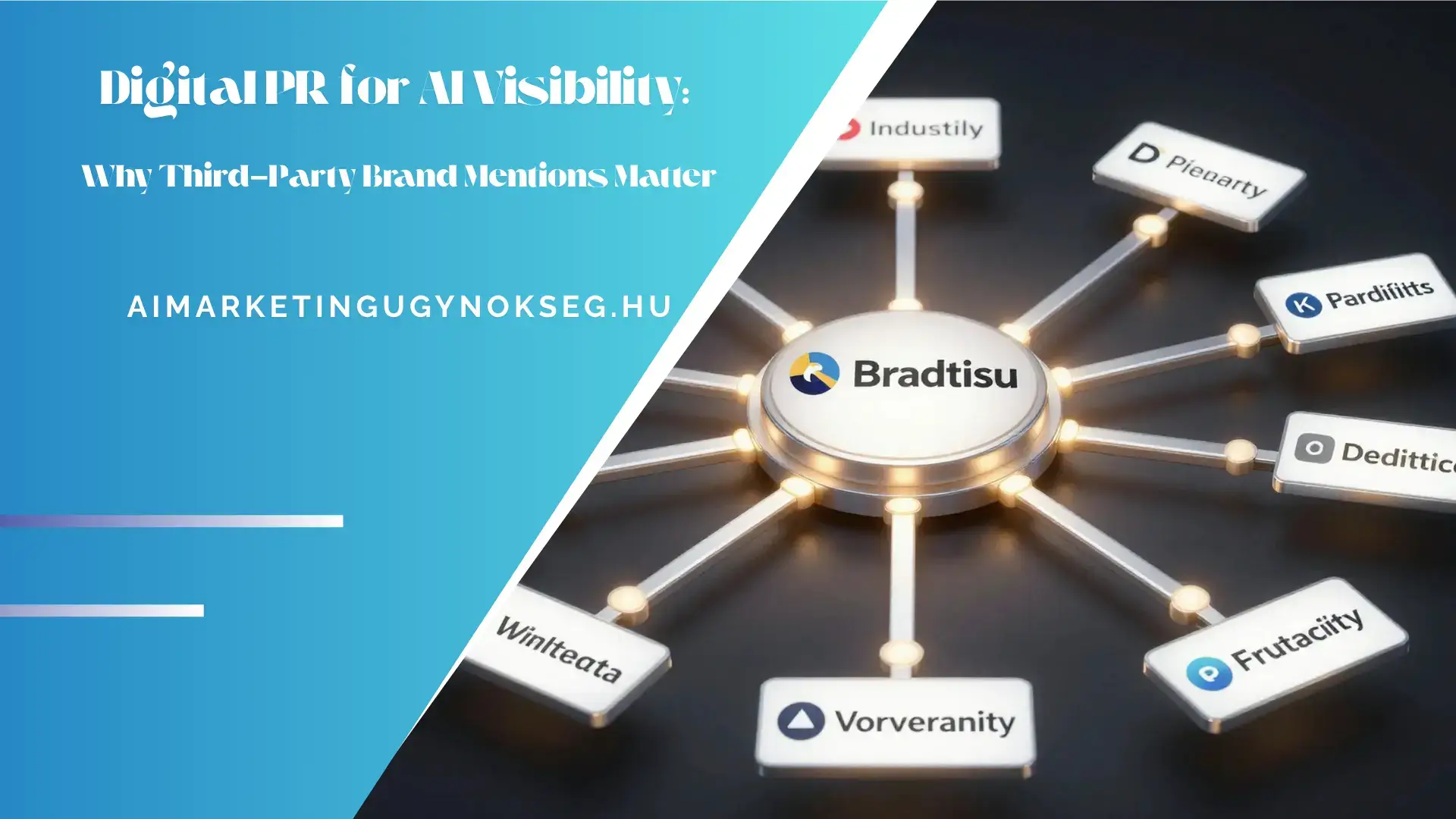
Digital PR for AI Visibility: Why Third-Party Brand Mentions Matter
O
In the AI era, what matters is not what you say about yourself — but how many independent, credible sources confirm it. This article shows how to build a deliberate external evidence network around your brand.
A business can claim almost anything about itself on its own website: market-leading, innovative, trustworthy, premium, experienced, customer-focused. Familiar words, right? The problem is that everyone uses them — and AI systems know this perfectly well.
For ChatGPT, Gemini, Copilot, Perplexity and Google’s generative search features, a claim appearing on your own website is not necessarily sufficient evidence by itself. A much stronger trust environment emerges when professional publications, partners, clients, conference organizers, researchers, podcasts and industry databases also speak about the brand consistently and coherently.
This is why digital PR in the AI era no longer means only media appearances and referral traffic. Its real purpose is to create the external evidence network that helps search engines and generative systems understand who the brand is, which topics it is credible in, which services it provides, where it operates, who it is connected to — and which claims can be safely associated with it.
If this topic is still new to you: it is worth first reading what AI visibility is and why it matters for Budapest businesses — this article builds on that foundation.
What does digital PR mean from an AI visibility perspective?
The difference between traditional PR and digital PR
Traditional PR primarily focused on media relations and reputation: appearing in the right places, being seen in a positive light and managing crises. Digital PR, by contrast, creates measurable online traces — a digital footprint interpreted not only by readers, but also by search and AI systems.
These traces include editorial articles, expert quotes, interviews, podcast appearances, conference speaker profiles, guest articles, research citations, partner and client-side mentions, relevant backlinks — and unlinked but clearly identifiable brand mentions as well.
Not every mention is equal
Before building a strategy, we need to clarify the concepts. Click each type and see how they differ:
Backlink
A clickable link to your website from another page. It creates a technical and navigational connection, helps page discovery and may also function as a relevance signal.
Source citation
The named use of a claim, data point or piece of research. “According to CRS Agency’s 2026 survey…” — this is the strongest form because it connects the brand to professional content.
Brand mention
The appearance of a company or expert name without a link. It is not clickable, but it strengthens brand awareness, context and the connection to a topic area.
Entity connection
The brand is connected to a topic, person, place or service — for example when a conference introduces someone as an “AI SEO expert.”
Recommendation / review
An experience-based opinion from an external party: client reference, case study or review. One of the hardest trust signals to fake.
From an AI visibility perspective, the number of mentions is not what matters most. Source credibility, topical relevance, context and consistency may matter more than a hundred low-quality appearances. We wrote about this in detail in our article AI brand mentions: visibility and trust in 2026.
Why is external validation more important for AI?
AI answers are built on sources and relationships
According to Google’s explanation, AI Overviews and AI Mode can launch several related searches behind a single question — this process is called query fan-out. The system can therefore look for different sources for different subtopics and claims, then assemble the answer from them.
The practical consequence is that a company’s visibility does not necessarily depend on a single landing page. It may matter just as much how other websites mention the brand, its services and its experts in different contexts.
External sources reduce uncertainty
Let’s look at a simple example. A business writes this on its own website:
“We are one of Budapest’s leading AI SEO agencies.”
By itself, this is a marketing claim — anyone can write it without proof.
A completely different evidence environment is created when a professional publication interviews the company’s leader; a conference introduces them as an AI SEO expert; a client names them in a case study; a university or research website references their methodology; and several relevant websites mention them in the same service category. At that point, the claim is backed by independent sources — and that is exactly what neither readers nor AI systems ignore.
AI interprets not only documents, but relationships
External appearances help connect the person to the company, the company to the service, the service to the target market, the brand to a geographic location, and the expert to a specific topic area. This is the essence of entity logic: the system does not build words, but relationships. To explore this mindset more deeply, we recommend our guide on entity-based SEO for AI visibility.
Which third-party appearances increase AI visibility the most?
Professional media appearances
The most valuable articles are not simple advertising copy, but contain genuine professional contribution: expert opinion, original data, methodology, forecast, case study or a new solution to an industry problem. Editors are willing to cite you when they receive something their readers cannot find elsewhere.
Interviews and podcasts
These build both the person entity and the business entity at once — a double win from an AI visibility perspective. It is important that every introduction consistently include the expert’s full name, the company name, the field of expertise, the website and the unique method or research area. Small inconsistencies — different company spelling, different title — weaken entity clarity over time.
Reuse of original research
Truly unique data creates a natural reason to cite. This may be an industry survey, benchmark, pricing study, consumer behavior analysis, AI visibility comparison, trend based on anonymized client data, or an original experiment and measurement methodology. Original research is the “evergreen currency” of digital PR: it can generate new citations for years.
Partner and client-side mentions
A reference on a partner website describing a real collaboration is more credible than any artificially created profile page. The digital trace of a genuine business relationship is a hard-to-copy competitive advantage.
Conferences, universities and professional organizations
These appearances provide especially strong context for expertise. They do not merely provide a link; they also show which topic an independent institution connects the expert to — and that is one of the hardest-to-earn, therefore most valuable, trust signals.
Reviews and community discussions
Forums, professional communities and review platforms are also part of the environment from which users and AI systems form a picture of a brand. One important warning: these should never be manipulated with artificial reviews — the risk is many times greater than the apparent benefit.
Backlink or brand mention — which is more valuable?
This is one of the most common questions we receive from clients — and the answer is that the question is framed incorrectly. The two tools serve different purposes. Switch between the views and compare them:
- It creates a technical and navigational connection between two pages.
- According to Google’s official documentation, it helps pages be discovered.
- It can also be used as a relevance signal in ranking.
- It can bring measurable referral traffic.
- It increases brand awareness in front of a relevant audience.
- It strengthens the connection between the entity and the topic area.
- It may trigger new branded searches.
- It functions as a reputation signal for readers.
- It may appear in documents where editors do not provide links for editorial reasons.
Important professional clarification: Google does not state that every unlinked brand mention is a standalone, direct ranking factor. It does make clear, however, that its generative search features assemble answers from the search index, multiple related queries and different sources — and it also warns that artificial or manipulative mention acquisition does not create real advantage.
The right question, then, is not “link or mention?” but rather: “What kind of external evidence best helps the brand appear as a credible player for a given question?” The ideal appearance includes the brand name, precise professional context, an original claim or expert contribution, author or company introduction, a relevant citation and consistent entity data.
You can read more about quality link acquisition on our premium link building and data-driven link strategy page — where we deliberately focus on relevant, high-quality, non-toxic sources, not mass link acquisition.
How do you build a digital PR strategy with AI visibility as the goal?
The following six steps form the framework of a complete, repeatable digital PR system. Open each one and move through them in order:
-
Do not try to become visible merely as a “marketing agency” — positioning that is too broad is also difficult for AI systems to interpret. Choose well-defined topic areas: AI SEO for Hungarian businesses, ChatGPT visibility, digital PR and GEO, AI visibility audit, international SEO, or AI marketing strategy for SMEs. The sharper the focus, the easier it is for a specific question area to become associated with you.
-
The foundation of a PR campaign should never be a generic company introduction, but something others consider worth citing: an original research finding, a concrete case study, a new methodology, a verifiable forecast, market data or a professional position statement. If you do not have a citable asset, even the best relationships will leave you with nothing meaningful to distribute.
-
Group potential appearance opportunities: national business media, professional portals, industry blogs, local Budapest websites, universities, chambers, conferences, podcasts, partner companies, client pages and international professional platforms. The map helps you build on deliberate priorities rather than ad hoc opportunities.
-
Do not send the same press release to everyone. A business publication cares about market consequences, a technology portal about the method, a local outlet about the Budapest impact, and a podcast about the personal expert story. The same raw material, four different narratives — this is the difference between mass-produced and real PR.
-
Every appearance should ideally use the same company name, expert name, position, service area, location, website address, professional profile and short introduction. Entity consistency is the invisible work that pays off over months — and its absence silently weakens even the best campaign.
-
The external article should point to a detailed owned source, while your own page should document the research method, full data, author expertise, update date and related case studies. This way, external mentions and your own content reinforce each other — to see how this works in practice, read how your website can become a citable source in Perplexity answers.
How can the AI visibility impact of digital PR be measured?
Classic PR metrics are not enough on their own. The number of appearances or estimated media value does not show whether the brand actually entered AI answers. The following metrics are worth tracking regularly — tick the ones you already measure today:
📊 AI visibility measurement list
0 / 12 metrics trackedAn important development is that Bing introduced its AI Performance interface in 2026, showing which pages are cited in Microsoft AI experiences, which queries they are connected to and how their citation performance changes. This clearly signals that AI visibility is gradually becoming a separately measurable marketing field — no longer a matter of belief, but of data.
You can find a detailed guide to the metrics worth tracking in our AI visibility dashboard article, and you can request an AI visibility audit in Budapest to assess your current position.
The most common digital PR mistakes in the AI era
Bad digital PR is not only ineffective — it can actively cause harm. These are the most common mistakes we encounter in practice:
⚠️ Buying mass, irrelevant appearances
Quantity does not replace topical relevance and editorial credibility. A hundred weak mentions are worth less than one strong one.
⚠️ Distributing the same advertising text everywhere
Verbatim repeated articles without added value do not build real expert positioning — only digital noise.
⚠️ Fake expert profiles and reviews
Artificial mentions create reputation and SEO risks. Google explicitly warns that chasing non-authentic mentions is not an effective strategy.
⚠️ Inconsistent brand data
If the company name, activity, leader or address appears differently in different places, it increases uncertainty around the entity.
⚠️ PR without a content asset
Without original data, research, a method or real news, it is difficult to earn quality editorial appearances. First the asset, then the campaign.
⚠️ Measuring only links
A high-prestige, unlinked expert quote may be more valuable for business and reputation than a clickable link from an irrelevant page.
We wrote a separate article about handling negative mentions and reputation risks: AI-powered brand protection and reputation in AI search.
Summary: digital PR builds an external evidence system
AI visibility cannot be secured with a single technical setting or a few artificial brand mentions. Lasting results require three layers working together: valuable and citable owned content; a technically accessible, clear website; and validation from independent third-party sources.
The most important result of digital PR, therefore, is not simply the backlink. It is that a verifiable, consistent knowledge network supported by multiple sources forms around the brand — an evidence system that neither a skeptical client nor a generative AI system can ignore. And this is precisely the difference between what a brand claims about itself and what the world confirms about it.
Do you know what the internet — and AI — says about you?
Are you unsure which sources currently mention your brand and how those mentions influence your AI visibility? An AI visibility audit reveals missing external trust signals, competitor advantages and the most valuable digital PR opportunities.
Request an AI visibility consultationFrequently Asked Questions
A direct ranking impact cannot be guaranteed. However, a relevant and credible third-party mention can strengthen brand awareness, context and professional credibility — and these may indirectly improve appearance in generative systems.
The main goal of link building is to acquire relevant backlinks. Digital PR is broader: it also builds brand awareness, reputation, expert positioning, media appearances and third-party mentions — the link often appears only as a byproduct of this process.
No. No single appearance guarantees a specific AI recommendation. Consistent expert content, clear entities and credible third-party validation, however, can significantly improve brand discoverability.
The most valuable appearance is one that reaches a relevant audience, appears on a credible platform, includes genuine expert contribution and provides accurate brand context. Prestige alone is not enough — topical fit matters just as much.
With regular, documented test questions, AI visibility platforms, Bing Webmaster Tools data, referral traffic, branded searches and competitor comparison. The key is consistency: measure trends, not one-off snapshots.


