
O
AI Visibility · Measurement Methodology
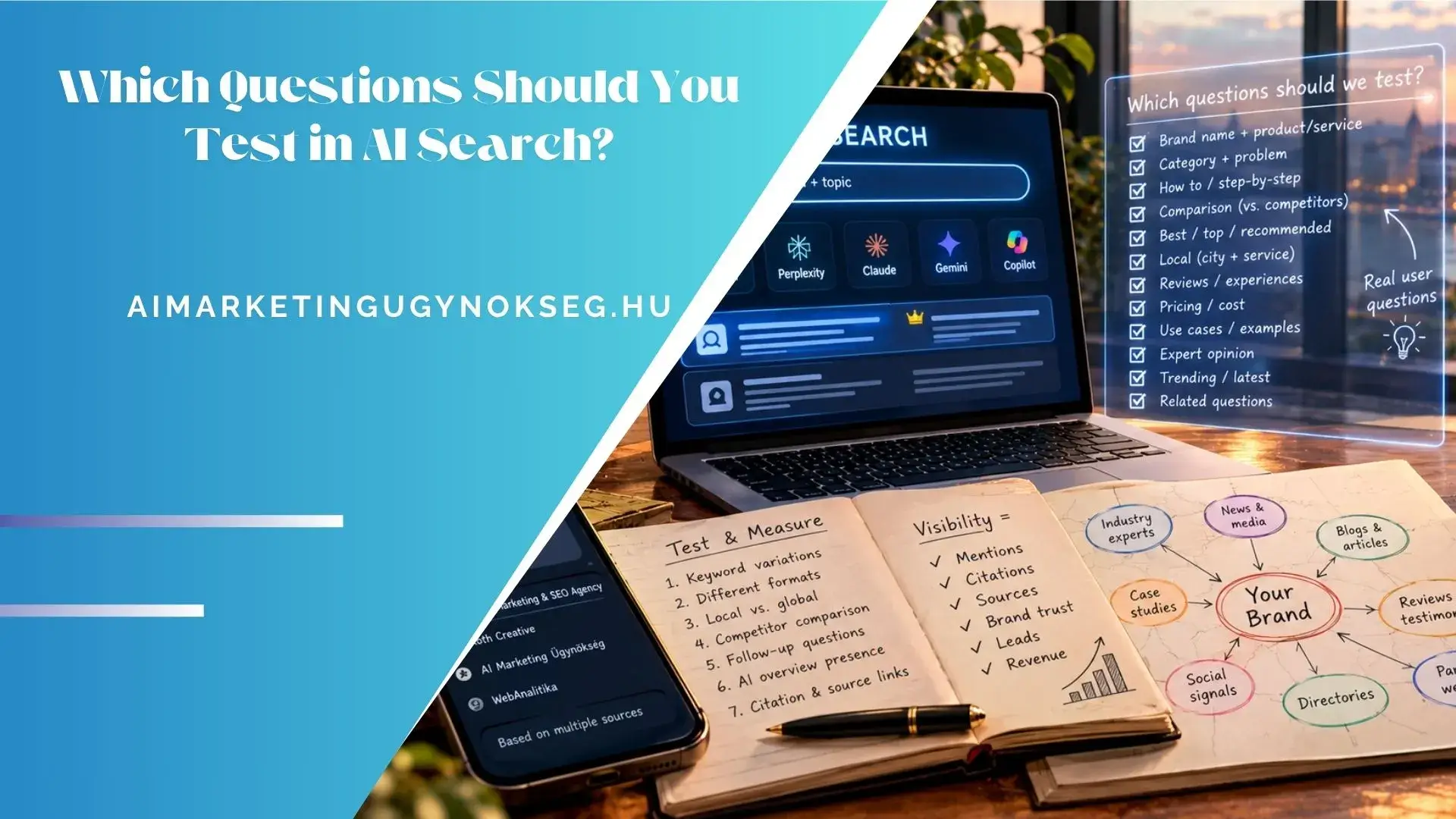
Which Questions Should You Test to Really See Where You Stand in AI Search?
Most companies ask ChatGPT a single question containing their own brand name and then draw conclusions about the entire market from the answer. But measurement does not begin with whether you can see yourself. It begins with whether you know which questions your revenue depends on. This article gives you a complete, documentable question set you can use from start to finish.
The Five Most Important Takeaways from This Article
- The foundation of measurement is not a ranking, but a fixed, documented question set that you rerun regularly.
- Questions should be weighted by purchase intent: start with questions such as “who can solve this?”, “who can I trust?”, “how much does it cost?” and “what makes them different?”.
- The most valuable test is the non-branded question – if you do not appear there, a flattering answer to your brand name is only an illusion.
- For every answer, record at least six things: presence, position, source, tone, accuracy and competitors.
- AI answers change from run to run, so never draw conclusions from a single measurement – repeat the test and look at proportions.
Why Is the Search Results List No Longer Enough?
In traditional search engine optimization, we are used to our position being a number that we monitor every week. In AI search, however, there is no such thing as “the tenth result.” There is an answer that mentions three or four names, and there is silence in which your company does not appear. This difference fundamentally changes what needs to be measured.
On Google’s search results page, the user chooses among the available options, so even tenth place can generate a click. In an AI assistant’s answer, however, the system itself decides whom to mention. If you are not included in the answer, you are not simply in a worse position – you do not exist. Moreover, the user typically does not ask another question but accepts the list of names provided and starts discussions from there. That is why measuring AI visibility is not about monitoring rankings, but about examining whether your name appears in a decision-making situation.
There is a second, less obvious difference: the answers cannot be reproduced exactly. The same question on the same day, in two different conversations, may produce a different order, different sources and sometimes different names. The logic of traditional rank-tracking tools breaks down here because the result of a single measurement may be random. This is not an error; it is the nature of the system: language models generate responses probabilistically while working from underlying sources. That is why measurement is not a snapshot but a series of measurements, where proportions and trends matter.
Third, AI does not merely list; it interprets. It combines, evaluates, recommends and explains. If contradictory information exists about you on the web – different company names, different service scopes, outdated pricing, missing references – the answer will reflect that confusion. Measurement therefore reveals both your visibility and the machine-generated picture of your brand. The latter is valuable business information in itself: it shows what the market thinks about you before anyone even speaks with you.
The Logic of the Question Set: Revenue First, Appearance Second
The most common mistake is that companies ask questions out of curiosity. “Who are we according to AI?” – an interesting question, but it measures nothing by itself because it is not connected to a decision-making situation. A useful question is one that your customer would ask before making a purchase, at the moment when they do not yet know you but already know they need to solve something.
That is why it makes sense to build the question set around purchase intent. At one end of the scale is the problem (“something is not working, who can help?”), and at the other is the decision (“is this specific company right for me?”). The closer a question is to the decision, the greater weight it deserves in the measurement – because losing visibility there directly costs money.
“I start with questions that signal real purchase intent: who can solve the problem, which supplier can be trusted, how much it costs, and how the alternatives compare. A fixed, documented question set provides the baseline for remeasurement – even when AI answers differ from run to run.”
The idea is based on a simple insight: just because an AI system knows about you does not mean it will recommend you. What matters is whether your company appears in the answer to a decision-related question as a credible, verifiable and unambiguous signal. The question set is therefore not designed to satisfy curiosity, but to reveal where trust is leaking out of the buying journey.
If the answer to a question does not influence whether someone contacts you, then that question is not a measurement point but entertainment. Only questions linked to a business decision should be included in the question set.
The Eight Question Groups You Need to Test
The following eight groups cover the entire buying journey from problem recognition to confirmation of the final decision. You do not need to ask ten questions from every category: two or three well-written questions per group already provide a measurable picture. Notice in the examples that your brand name appears only where this is intentional – the other questions are the real test.
Problem- and Solution-Awareness Questions
Where it is decided whether you are considered at allThese are the earliest questions: the buyer does not yet know the names of the solutions, only the symptom. Here, AI identifies the category and possible types of solutions. If your category does not appear at all at this stage – for example, because the answer discusses only advertising and social-media management but says nothing about AI visibility – you will not be in the running in later questions either. This group is the most undermeasured, even though it may contain the greatest growth opportunity.
Sample Questions
- A Hungarian webshop’s traffic is growing, but conversion is not. What solutions should be investigated?
- How can a B2B company’s name get included in artificial-intelligence answers?
- What tools and services are available for a company to measure its visibility in search?
Supplier- and Service-Provider Search Questions
Where the shortlist is createdAt this point, the buyer is already looking for a specific service, and AI creates a shortlist. This is the most important commercial measurement point in service markets: if you are not among the first three or four names mentioned, in practice you do not exist at the pre-decision stage. Pay particular attention to who appears instead of you – the composition of the list is competitive analysis in itself.
Sample Questions
- Which Hungarian agencies should a company contact if it wants to improve in AI search optimization?
- Who provides AI visibility consulting for mid-sized companies in Hungary?
- Which SEO agency would you recommend to a Budapest-based B2B software company?
Trust and Expertise Questions
Where evidence decidesWhen the buyer asks, “who has genuine experience in this?”, AI looks for evidence: case studies, professional mentions, publications, reviews, awards and specific names. This question group ruthlessly shows whether your expertise is visible on the web, not merely in your head. If your name is not associated with your area of expertise in machine interpretation, this is where otherwise strong services will fail.
Sample Questions
- Who is considered an expert in AI search optimization in Hungary?
- Which agency has verifiable experience in complex B2B markets?
- Who would you trust with a project where the company’s name needs to appear in ChatGPT answers?
Price and Cost Questions
Where accuracy regulates lead qualityPrice questions are particularly interesting because AI tends to be cautious or mix global pricing with the Hungarian market. If the answer provides an international price level while you work in Hungarian market conditions, you may receive prospects with incorrect expectations while also losing those who think you are too expensive. That is why, for price questions, you should measure not only presence but also numerical accuracy.
Sample Questions
- How much does a monthly AI visibility program cost for a Hungarian mid-sized company?
- What is the average fee of an SEO agency in Hungary?
- Is it worth a 50-person company spending separately on search engine optimization, and what return can it expect?
Comparison and Alternative-Search Questions
Where competitors appear directlyThis is the toughest group because your name and competitors’ names appear together. AI does not merely list in this situation; it explains the differences – and if you do not have a clear differentiator that can be translated into machine-readable language, it will probably favor one of the better-known names. Pay attention to which characteristics it associates with you, because those provide the strongest possible content-priority list.
Sample Questions
- CRS AI Marketing & SEO Agency or a traditional SEO agency: which should I choose, and why?
- What are the best alternatives if a company is looking for an AI visibility program?
- How is generative search optimization different from traditional search engine optimization?
Brand-Focused Questions
Where you discover what the system “believes” about youHere, the user asks directly about your name. This is not a visibility test but a brand-image test: does it spell the company name correctly, describe the right services, mention the correct partners, and avoid outdated information? It is very common for a company to appear inaccurately even in an answer specifically about its own name – because AI works from contradictory sources found across the web. This is the easiest error to fix and usually produces the fastest measurable improvement.
Sample Questions
- What does CRS AI Marketing & SEO Agency do, and what services does it provide?
- Is CRS AI Marketing & SEO Agency a good choice for a mid-sized company?
- What reviews are available about CRS AI Marketing & SEO Agency?
Local and Narrowing Questions
Where the Hungarian market begins to stand apartBy default, AI tends to recommend large international brands and provide global advice. For a Hungarian small or mid-sized business, however, the useful answer is one that names a locally available partner that works in Hungarian. That is why every question set should include at least two or three questions containing geographic or segment-specific narrowing. This reveals whether your local entity is strong enough for the system to associate Budapest or Hungary with your company.
Sample Questions
- Which AI marketing agencies operate in Budapest, and which would you recommend for cooperation in Hungarian?
- Which agency specializes in search engine optimization for webshops in Hungary?
- Who provides AI visibility audits for Hungarian small businesses?
Decision-Support and Objection-Handling Questions
Where trust becomes solid or disappearsIn the final stage, the buyer already knows you but is hesitating. They ask about risks, timelines, guarantees and pitfalls. If the answers are uncertain, generic or describe a competitor’s practice instead of yours, you lose the customer at the most expensive stage. This group is also valuable because the answers directly reveal which objection nobody on the web is currently addressing.
Sample Questions
- How long does it take to see results from an AI visibility program, and what is its biggest risk?
- What guarantees should agencies provide, and what claims should not be believed?
- What should I ask an agency during the first meeting to determine whether it understands AI-powered search?
How Do You Write a Question That Can Be Measured?
The wording of the question itself influences the result. If you ask a short question without context, AI will provide a generic answer, and large brands dominate generic answers. With a specific, realistic situation, however, the system has to look for names that fit the context – and this is where you have a chance.
That is why it makes sense to build every question from five elements. This structure ensures both repeatability and that the answer genuinely relates to your market.
1. Role
Who is asking? “You are the owner of a Hungarian webshop…” – this immediately sets the tone and level of detail.
2. Situation
What is the specific problem or constraint? Size, industry, objective, background – without these, the answer will be generic.
3. Task
What are you asking for? A name, list, explanation, comparison or price. Make the requested output unambiguous.
4. Market and Language
Hungary, Hungarian language, forints, domestic providers – without these, you will receive an international answer.
5. Format
“List five, with one sentence explaining each.” The format creates comparability for later measurements.
In Addition: Do Not Give Away the Answer
The non-branded question is the real test. Use the brand name only in questions specifically focused on the brand.
If you could place your question into another country’s market and it would work exactly the same way, then it is not specific enough yet. A good measurement question is always tailored to your market: Hungarian language, domestic providers, realistic company size and a real decision-making situation.
Documentation: The Backbone of Measurement
Because AI answers vary, the value of measurement lies not in an individual answer but in consistently repeated measurement. For two measurements to be comparable, however, every relevant condition needs to be recorded. If one month later you cannot remember exactly how you asked the question, which tool you used or which language you used, then you did not perform a measurement – you collected an impression.
A simple spreadsheet is enough. The following columns are the minimum required for credible comparison later.
| Column | What It Contains | Why It Matters |
|---|---|---|
| Identifier | For example Q-04, so the question can be referenced | A short reference for reports and task lists |
| Exact Question | Exactly as asked, without correction | This is the only guarantee of comparability |
| Type and Weight | Which of the eight groups it belongs to and what business weight it receives | This makes the score reflect revenue rather than appearance |
| Environment | Date, tool, model, language, logged in or not | Together these determine the answer you receive |
| Number of Runs | Typically three repetitions per question | No conclusion can be drawn from a single run |
| Result | Score, names mentioned, sources and notes | Qualitative observations determine the next steps |
Two additional things are worth recording because they are often omitted in practice. The first is the unchanged question set: if you rewrite the questions every month, you will never have a trend. The second is the version number: if you do change a question, introduce it with a new identifier and retain the old one as a comparison baseline. This preserves the historical data.
What Should You Measure in the Answers?
The question “are we included?” is too crude to support executive decision-making. An answer contains much more information, and those elements have different business consequences. Six dimensions are worth recording for every answer.
Presence
Whether your name appears in the answer at all, or only your competitors’ names do.
Position
Whether you are the first name mentioned, among the first three or at the end of the list.
Citation
Whether the answer links to a source and, if so, whether it cites your website or a third party.
Tone
Whether the picture created about you is neutral, positive, uncertain or explicitly negative.
Accuracy
Whether the company name, service scope, size, price and location are correct. This is where factual errors become visible.
Competitors
Who is mentioned instead of you and with what justification. This is the best possible content-priority list.
A Score That Can Be Added Up
Of the six dimensions, the simplest approach is to combine presence and position into a single four-point scale and treat the remaining dimensions as additional signals. A four-point scale is practical because the extreme values are unambiguous while the intermediate values do not drift too far into subjectivity.
| Score | Meaning | Business Interpretation |
|---|---|---|
| 0 | Not included in the answer | Invisible You do not exist in the decision-making situation. |
| 1 | Mentioned, but incorrectly, negatively or only in passing | Risk An incorrect picture is created about you. |
| 2 | Included in the list, but not near the top, with neutral justification | Partial You are present, but not the first choice. |
| 3 | Mentioned first or among the first three, accurately and with justification | Strong You have a genuine chance of being contacted. |
This can be turned into a single metric that is suitable for presenting to management. The formula is simple: multiply each question’s score by its weight, add the values together and divide the result by the maximum available score. The result is a percentage expressing your visibility across commercially important questions.
AI Visibility Score = sum of (weight × score) ÷ sum of (weight × 3) × 100
Example: twelve questions, 40 total weight points, achieved value 68. The score is 68 ÷ 120 × 100 = 57%. It is also worth calculating the same figure by question group – this reveals whether the weakness lies in trust questions or pricing questions.
The score should always be accompanied by measurement uncertainty. Because answers change from run to run, a movement of 5–10 percentage points may still be noise. A trend that persists across two or three consecutive measurements is what deserves strategic attention. This approach protects you from reallocating the entire budget after one good month, and from panicking because of one poor run.
A Working Measurement in Practice
Imagine a Hungarian B2B software company with twenty employees operating in Budapest. Management knows that some decision-makers already ask AI before the first meeting, but they have no idea what happens when they do. We create a twelve-question set: three problem-awareness questions, three service-provider search questions, two trust questions, two pricing questions, one comparison question and one brand-focused question.
The first measurement produces a typical pattern. For the brand-focused question, the answer is acceptable: the company name appears correctly and the description of the service is broadly accurate. In the problem-awareness questions, however, the company does not appear at all because there is no content on the web connecting the problem and its solution with the company’s name. In service-provider search questions, three large international providers appear instead. For the pricing question, the answer gives a global price range that is approximately twice the Hungarian market reality.
This measurement produces three very specific tasks. First, create a page that names the problem and presents possible solution paths – this targets the problem-awareness questions. Second, create a pricing page for the Hungarian market with public ranges – this improves the pricing question. Third, create a comparison page that contrasts the company’s own approach with traditional alternatives in a factual and citable way.
Three months later, the score typically does not double, but the structure changes. The company name begins to appear in problem-related questions, the Hungarian price range appears in pricing questions, and the comparison question includes the company together with justification. The accuracy of brand-focused answers improves because the information across the web finally points in the same direction. This is the realistic pace: not overnight, but question group by question group, building one layer upon another.
The company described here is an example, not client data. The example is included to demonstrate the reasoning process: measurement, gap analysis, content intervention and remeasurement.
Curious What AI Currently Says About Your Market?
We run the ten questions in your own segment and show you where the largest gap is – using your own numbers, not generic promises.
The Seven Most Common Mistakes
You test only with your brand name. If the company name appears in the question, AI will answer about you, but you will not learn whether you would appear in the situation of an unknown buyer. The real test is the non-branded question.
You draw conclusions from a single run. Answers change. With three repetitions, you can already begin to see whether a mention is random or stable.
You do not document the exact wording. If you ask the question differently every month, the two results are not comparable and the trend becomes meaningless.
You measure on only one platform. Different assistants may use different sources. It is worth measuring on at least two platforms and treating the results separately.
You look only at whether you appear. A mention in the wrong context can be more damaging than no mention at all. Tone and accuracy are at least as important as presence.
You measure curiosity questions. Interesting questions that are not connected to a decision divert attention away from what really matters: questions close to purchase intent.
You show management only one number. A visibility score without context is misleading. It should always be accompanied by a breakdown by question group, competitor comparison and measurement uncertainty.
30-Day Implementation Plan
If you are starting from zero, these four weeks are enough to build a working, documented measurement system – and your first concrete action list.
Week One: Build the Question Set
Select eight to twelve questions from the eight groups and assign a business weight to each one. Write down the final wording exactly and lock the version. The result: a fixed, versioned question list.
Week Two: The First Measurement
Run the set three times on at least two platforms and record the six dimensions. Do not evaluate as you go – only collect. The result: a baseline score and a raw collection of answers.
Week Three: Gap Analysis and Prioritization
Review each question group to find the largest gap and identify which competitor appears with which justification. Select two or three questions with the greatest business value. The result: a short, justified intervention list.
Week Four: Intervention and Remeasurement
Create or correct the missing content, entity data and citable evidence. At the end of the month, repeat exactly the same measurement. The result: two comparable measurements and the beginning of the next cycle.
Frequently Asked Questions
Are Ten Questions Enough for a Serious Measurement?
A set of ten to twenty questions is sufficient for most Hungarian small and mid-sized businesses. The key is not quantity but coverage: include at least one question from each of the eight groups, and give more questions to the commercially most important groups. A thirty-question list that nobody evaluates regularly is worth less than a ten-question list that you rerun every month.
How Often Should the Measurement Be Repeated?
During the initial period, monthly measurement is appropriate; after interventions, it may be useful to check every two weeks depending on the size of the expected change. If nothing moves across two or three measurements after a content improvement, the problem is not the measurement but the direction of the intervention. A monthly rhythm works well because it is frequent enough for learning while still allowing enough time for random noise not to dominate attention.
Does Every AI Assistant Give the Same Answer?
No, and that is not a problem. Different platforms may use different sources, give different weight to fresh content and select citations differently. Measurement is therefore credible only when you record separately which platform produced the result. The difference between two platforms is valuable information in itself: it shows how stable your visibility is and whether one system uses a source that the other does not.
Do I Need a Paid Measurement Tool?
Not necessarily. For your first measurement aimed at learning, a simple spreadsheet is enough if you maintain it consistently. Paid tools become worthwhile when you work with many questions, multiple markets and regular reporting requirements. The order matters: first establish the question set and scoring logic, and only then introduce automation. Doing it in the opposite order typically produces attractive dashboards that do not tell you what to do.
What Counts as a Good Result?
There is no universal good number because the starting point varies greatly by market and industry. The purpose of the first measurement is not to pass a threshold but to establish a baseline. From the second measurement onward, change becomes the benchmark: an increase in the share of mentions across commercially important question groups, improved accuracy and growth in the number of cited sources all count as progress. If all three improve together, the system is moving in the right direction.
How Does This Relate to Traditional Search Engine Optimization?
The two are not competitors. Traditional search engine optimization ensures that your site is crawlable, fast and understandable, and that your content appears in search results. AI visibility adds another question: whom does the system name in its answers? In practice, the same improvements often support both: clear page titles, well-structured sections, concrete data, citable claims and consistent company information. From a measurement perspective, however, they should still be treated separately because the two interfaces do not reward exactly the same things.
How Long Does It Take Before Change Becomes Visible?
The accuracy of brand-focused questions typically improves within a few weeks because your own pages and consistent data can have a relatively fast effect there. Change is slower in service-provider search and comparison questions and may require several months of development because external sources, professional mentions and competitor presence also matter. That is why different question groups should be assigned separate, realistic timelines – and those timelines should be written down in advance so expectations remain clear later.
Let’s See What AI Says About You Right Now
We will run the ten questions for your market and spend 15–20 minutes reviewing where the biggest gap is. The result will either reassure you or be uncomfortable – but afterwards you will know more than you do now.
Free of charge, with no obligation. Response within 2 business days.

